

The Happy Buddha: A Guide to Joy and Luck
Have you ever experienced this—waking up to a blaring alarm, squeezing into a subway like a sardine in a can, staring blankly at a computer screen at work, and then having to deal with social obligations after clocking out? At times like these, I can’t help but think of a very special guest: our beloved Laughing Buddha!
Look at his round belly, which looks like he’s hiding a six-month-old watermelon inside. And that ever-smiling mouth—it’s wider than if he’d just won the lottery. Seriously, every time I see the Laughing Buddha, I wonder if he’s secretly been let in on some cosmic joke, like tomorrow being an unexpected holiday or the boss suddenly deciding to give everyone a raise.
In an era where even our coffee needs to be “instant,” we could all learn a thing or two from the Laughing Buddha’s millennia-old wisdom. After all, when your phone battery is down to 1%, his smile is still at 100%. Isn’t that something worth embracing?
Table of Contents
1. Who is the Happy Buddha? The Story Behind the Smile
2. Bringing Good Luck: How to Place Your Happy Buddha
3. Simple Joy: The Happy Buddha’s Guide to Modern Life
4. A Little More Smile, A Little Less Stress
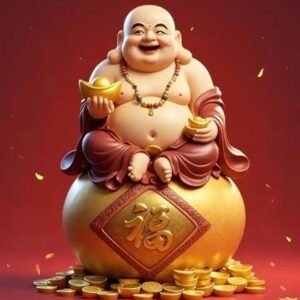
Who is the Happy Buddha? The Story Behind the Smile
You’ve probably seen him in restaurants or shops: a cheerful, round-bellied figure with a big smile and a sack. This isn’t just any statue; he’s the Happy Buddha, a beloved symbol of joy and good fortune in Chinese culture.
But where did he come from? His story begins with Maitreya, a compassionate Buddha from ancient Buddhist teachings. When Buddhism came to China, people wanted a more friendly and relatable figure. So, over time, the image of Maitreya transformed into the laughing, generous man we know today. He isn’t a god to be worshipped, but a wise friend who reminds us to be kind, open-hearted, and to always find a reason to smile.
His famous saying tells us everything:
💎”Big stomach can contain all things of the world.” (Be tolerant and let go of annoyances.)
💎”Laughing mouth welcomes all fortunes.” (A positive attitude attracts good things.)
Bringing Good Luck: How to Place Your Happy Buddha
In the practice of Feng Shui (an ancient Chinese art of arranging spaces to create harmony), the Happy Buddha is a powerful symbol for attracting positive energy, or Chi.
Think of him less like a magical charm and more like a daily reminder to invite happiness into your home. If you have a statue, here’s how to place it thoughtfully:
💎The Best Spot: Place him where you can see him often, like a living room shelf or your office desk. A good rule is to put him near the entrance, so he “welcomes” good energy into your home.
💎Height Matters: Place him respectfully. It’s best if he is at or above eye level when you are seated, not on the floor.
💎What to Avoid: Don’t put him in low-energy places like the bathroom, laundry room, or a dark corner. Keep his area clean and happy!
People believe that rubbing his belly gently from time to time can help bring wealth and good luck. But the real secret is this: seeing his smile every day naturally makes you feel more optimistic, and that is what truly attracts good fortune.
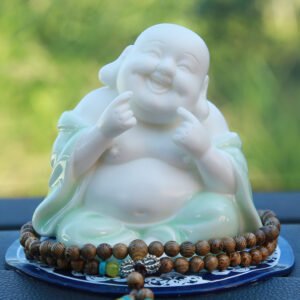
Simple Joy: The Happy Buddha’s Guide to Modern Life
The Happy Buddha’s wisdom is perhaps more useful today than ever before. In our busy world of stress and screens, he teaches us three simple lessons:
1. Choose to Be Calm and Tolerant (His Big Belly): His large stomach symbolizes the ability to “stomach” problems and let things go. When you feel stressed or angry, remember his belly. Take a deep breath and don’t let small things ruin your day.
2. Choose to Smile (His Laughing Mouth): Science proves that even a fake smile can make you feel happier. The Happy Buddha is the master of this. Start your day by smiling at yourself in the mirror. It’s a simple trick that can change your whole outlook.
3. Appreciate the Present Moment: He is often shown enjoying himself. He doesn’t wait for the future to be happy; he finds joy right now. This is a powerful lesson to put down our phones, appreciate what we have, and find contentment in the present.
A Little More Smile, A Little Less Stress
The Happy Buddha is more than a decoration. He is a timeless teacher of joy. He crossed oceans and centuries to deliver a simple message: happiness is a choice we make through tolerance, a positive mind, and a warm smile.
You don’t need a statue to follow his wisdom. Just try to carry his spirit in your heart. Be a little more patient, find a reason to laugh every day, and share your kindness with others. That is how you attract true and lasting good fortune.